Kitchen renovation budgets: where the money actually goes
By Farah Moreau · Updated 2026-07-16

A full kitchen renovation isn’t just a bigger version of swapping some units, it’s a different kind of project, with more trades, more sequencing, and more places for the budget to move. Knowing where the money is actually going helps you spot a quote that’s missing something, and decide where it’s worth spending more.
The headline numbers
For a 14 square metre kitchen with no structural work, a standard specification renovation, covering units, worktop, plumbing, electrics, flooring and decoration, tends to land around £16,700 to £24,500. Move to a premium specification and that range rises to roughly £26,700 to £39,200 for the same size room. Add structural work, removing a wall, for instance, and costs climb further on top of whichever specification you choose.
| Kitchen size | Standard spec, no structural work | Premium spec, no structural work | Standard spec, wall removed |
|---|---|---|---|
| 14 sqm | £16,700 – £24,500 | £26,700 – £39,200 | £21,700 – £31,900 |
These are whole-project figures, not just the fitting labour covered in a smaller unit-swap job. They assume a domestic kitchen with no major surprises once work starts.
Where the budget actually goes
Units and worktop. Typically the single largest line item. This covers cabinetry, doors, handles, and the worktop material and fitting, and it’s where specification level (flat-pack through to bespoke) moves the total the most.
Plumbing and electrics. First-fix and second-fix work for sink, hob, extractor, dishwasher and sockets. Costs rise sharply if anything is being repositioned rather than reconnected in place.
Plastering, flooring and tiling. Making good walls after strip-out, new flooring if it’s being replaced, and splashback or floor tiling.
Decoration and finishing. Painting, cornicing, plinths, and general snagging once everything else is in.
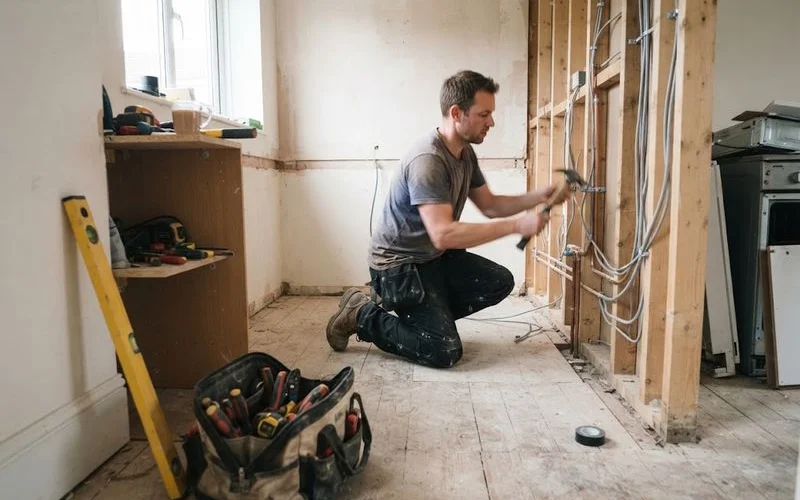
Structural work, if applicable. Removing a wall or extending the room adds building work, often structural steel, and typically needs building control involvement, which is a separate cost stream from the kitchen fit itself.
Where budgets commonly go wrong
The most frequent overrun isn’t dishonesty, it’s an unpriced surprise once the old kitchen is stripped out. Damp behind old units, wiring that doesn’t meet current standards, or an uneven subfloor are all more likely in older properties than newer ones, and none of them are visible until strip-out happens. Building in a contingency of roughly 10 to 15 percent on top of your quoted figure is a reasonable buffer rather than an admission that something will definitely go wrong.
The other common gap is appliances. Some quotes include integrated appliances as standard, others price the kitchen shell only and leave you to buy and fit appliances separately. Confirm which you’re getting before comparing quotes side by side, since it can shift the headline number by a meaningful amount without the fitting work itself being any different.
Where it can be worth spending more
Not every part of the budget is worth stretching for, but a few choices tend to pay off over the life of the kitchen. Worktop material is one: a hard-wearing surface that resists scratches and stains costs more upfront but avoids an early refresh. Cabinet carcasses are another, since a sturdy carcass holds hinges and drawer runners properly for years, while a weaker one can start showing wear within a couple of seasons of daily use. Conversely, cosmetic finishes like handles or splashback tiles are easier and cheaper to change later if your budget is tight now, so they’re a reasonable place to economise if something has to give.
Building in a sensible contingency
A contingency isn’t an admission that your fitter has under-quoted, it’s a recognition that some things genuinely can’t be assessed until the old kitchen is out. Keep it in a separate mental (or actual) pot rather than folding it into the headline budget, so you’re not tempted to spend it on upgrades before strip-out has even happened. If the job finishes without needing it, that’s a good outcome, not a wasted allowance.
Getting quotes you can actually compare
Ask for an itemised breakdown covering units and worktop, labour by trade, structural work if relevant, and decoration, rather than one lump sum. That makes it possible to see exactly where two quotes diverge, and whether a cheaper headline figure is genuinely cheaper or just missing a line item the other quote included.
For full kitchen renovation and remodelling specialists working across Bristol, project scope and pricing structure both vary, so treat the ranges above as a planning starting point rather than a quote. Browse the Bristol kitchen fitters directory to compare local firms, and see our scoring methodology for how rankings on this site are calculated.
FAQ
- What does a full kitchen renovation cost in Bristol?
- For a 14 square metre kitchen with no structural work, a standard specification tends to land around £16,700 to £24,500 total, covering units, worktop, plumbing, electrics, flooring and decoration. Premium specifications or added structural work push that considerably higher.
- What's the biggest cost in a full renovation?
- Units and worktop usually account for the largest single share of the budget, followed by labour across plumbing, electrics, plastering and tiling. Structural changes, removing a wall or extending the room, add a separate and often underestimated cost on top.
- Should I set aside a contingency for a renovation?
- Yes. Older properties in particular often reveal issues once walls or floors are opened up, damp, outdated wiring, uneven surfaces. A contingency of around 10 to 15 percent on top of your quoted budget is a reasonable buffer.
- Is it worth paying for a higher specification?
- It depends on how long you plan to stay and how hard the kitchen gets used. Higher-spec units and stone worktops cost more upfront but tend to hold up better over time, which matters more if you're not planning to move soon.
Related on this site
- Browse full kitchen renovation & remodelling providers
- Best full kitchen renovation & remodelling in Bristol →
- How long a kitchen renovation takes and what affects the timeline
- Do you need planning permission to remove a wall for an open-plan kitchen?
- What a new kitchen costs in Bristol and what changes the price
- Worktop costs by material: laminate, wood, quartz and granite compared
- All guides →